Sponsored by:
農研機構
スマート農業実証プロジェクト「高品質シャインマスカット生産のための匠の技の「見える化」技術の開発・実証」(2020–2021年度)
生物系特定産業技術研究支援センター
戦略的スマート農業技術等の開発・改良「AI駆動型栽培体系:人間とロボットの協働によるシャインマスカット栽培の高効率・高品質化」(2022–2024年度)
ひろしま型スマート農業推進事業「ぶどうの⼤規模経営の実現に向けた効率的な作業体系 の構築」(2022–2024年度)「ぶどうAI摘粒支援システム」
Berry number estimation and berry thinning are critical tasks in grape cultivation, directly affecting cluster shape, fruit quality, and market value. These tasks are traditionally time-consuming and highly dependent on experience, as growers must repeatedly count berries during thinning and rely on expert judgment to achieve an ideal bunch shape. This creates a significant burden for new and young farmers, especially during the short and labor-intensive berry-thinning season.
To address this challenge, we developed a smart–glass–based support system for predicting berry numbers and berry thinning. The system uses the same AI models as the Tsubura application (link to the Tsubura Page), which was also developed by members of our laboratory, ensuring reliable berry recognition and counting performance.
In operation, farmers simply wear the smart glasses and place a grape bunch inside a designated green guide box. The AI system automatically estimates the number of berries with an error of within ±1% and identifies berries to be removed with a thinning target judgment accuracy exceeding 95%. As illustrated in the blue guide box on the right, berries selected for removal are highlighted in red. A blinking visual effect indicates correct thinning, and the predicted berry count is displayed beneath the guide box. The system visually highlights the next berry to be thinned and provides audio guidance, playing a “Hi cheese!” sound each time a new target berry is displayed.
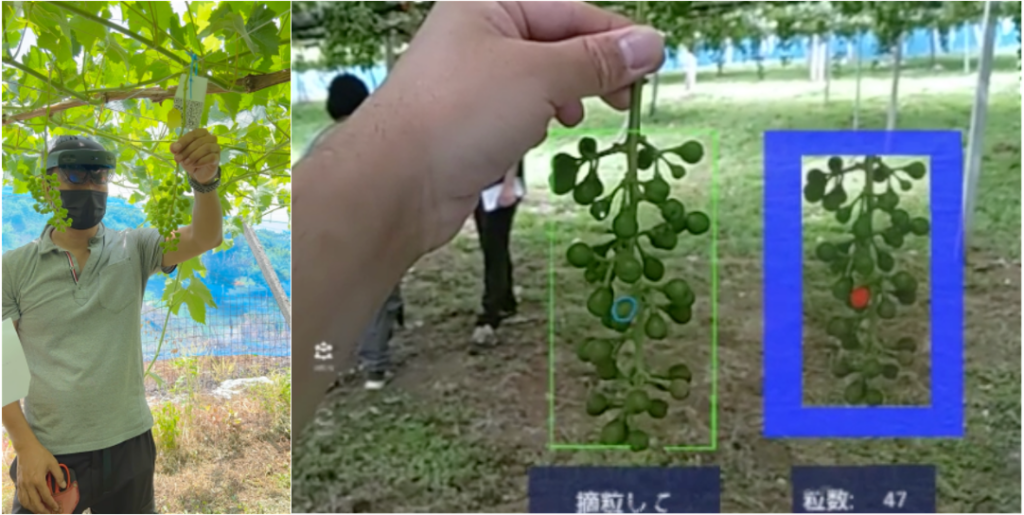
The thinning process continues until the target number of berries—typically around 30–35 per bunch—is reached, after which the system notifies the user that the task is complete. By eliminating the need for manual counting and reducing dependence on experience, this system enables inexperienced farmers to perform high-quality thinning work. It allows the use of temporary or part-time workers during peak thinning periods.
Publications
- Buayai, P., Yok-In, K., Inoue, D., Nishizaki, H., Makino, K., & Mao, X. (2023). Supporting table grape berry thinning with deep neural network and augmented reality technologies. Computers and Electronics in Agriculture, 213, 108194, doi: https://doi.org/10.1016/j.compag.2023.108194.
- S. Tamura, P. Buayai, W. -D. Chang, and X. Mao, “AR Grape Thinning Support,” 2024 International Conference on Cyberworlds (CW), Kofu, Japan, 2024, pp. 308-314, doi: 10.1109/CW64301.2024.00043.